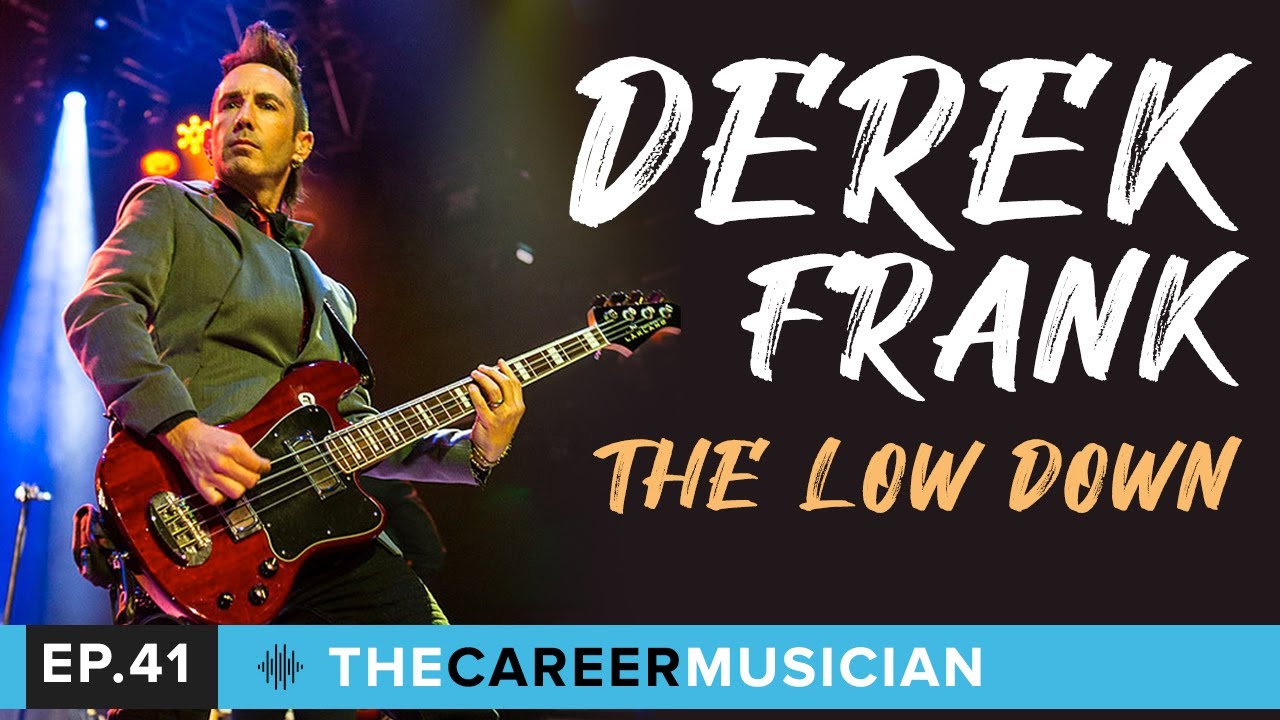
The Low Down: Derek Frank on Life as a Touring and Session Bassist (Episode 41)
You learned how to make music. Nobody taught you how to make a living making music.
Derek Frank lives right down the street from Nomad in Burbank, which is a very Burbank thing to say. Half the garages in town have a studio in them, and Derek's three-car garage was the main reason he bought the house.
In Episode 41 of The Career Musician, Derek dishes the low down on life as a touring and session bassist. At the time of the conversation he was splitting his time between Gwen Stefani and Shania Twain, with both artists running Vegas residencies in the same theater. How does a working bassist juggle two gigs like that without dropping either one? Mostly by paying attention.
Learn it because the gig needs it
Derek started on guitar, then spotted a bass on the wall of a music store while he was waiting for his lesson. That was it. He saved up caddying money and bought his first bass.
When his family moved to Cleveland, the high school had no bass players, so he got thrust into everything: jazz band, concert band, pit orchestra for the musicals, even marching band on a wireless because they had no tubas. He was a thrash metal kid who had never read a note. So he learned. He would sit in bed with a reading book, a flashlight and a pencil, nod his head to find the quarter note and tap out rhythms for half an hour before sleep.
He still does a version of that today, charting tunes for the next gig on long flights. Sink or swim made him a reader, and reading made him hireable. From there it was the Ohio Jazz Orchestra for Youth, a senior year at Interlochen and four years at the University of Miami, the only school he auditioned for.
The cruise ship shed
Through high school and college, Derek's summer job was cruise ships. Six nights a week, different music, reading charts behind whatever singers came on. After the show the band would jam until 3 a.m., and some nights Derek would stay in the empty showroom and practice until 7 a.m. No phone, no email, nobody bothering him.
He and Nomad both recommend it to young players who are single and free. No rent, money in the bank, a ton of playing, and relationships that last. Derek is still in touch with a lot of the people he played with on ships.
Even LA happened sideways. After Boston didn't work out, he went back to the ships, then stopped in LA for what was supposed to be a couple of weeks at his parents' place on the way to San Francisco. He started doing jazz gigs around town and never left.
How to sub out a big gig
This is the business core of the episode. Very few artists pay retainers these days, so everyone in a touring band has other work, and conflicts happen. Derek's protocol is simple. The first person to look to is whoever did the gig before you, assuming they left on good terms, because they already know the show. Then prepare your sub with whatever you used to prep: board recordings, charts, all of it.
Nomad asked the uncomfortable question. What about the fear that your sub will be so good they keep the chair?
"The people that I'm gonna call are not gonna do that to me, and they know I'm not gonna do that to them."
Derek Frank, 24:44
Most bass players get their gigs from other bass players who need a sub or are stepping out of something. That is the unspoken creed. Work begets work, and it only keeps flowing if nobody is stabbing anybody in the back. Leave every gig on good terms, because the next call may come from the person who had it before you.
Derek also keeps a full set of gear living with each gig. Two Kemper profilers and three basses stay with one camp, a trunk of basses and another profiler rig stays in Vegas with the other, so he can go straight from one gig to the next. For fly dates he brings one bass and a small pedalboard and backlines the rest.
Read the room on stage
Nomad called Derek's showmanship as strong as his playing. Derek says it is mostly observation. If everybody on stage is jumping around and you are staring at the floor, that won't work. If the band is mellow and you are running around like a maniac, that won't work either. Be interesting to look at without upstaging anyone.
The Gwen gig is a full cardio workout, which is why staying fit on the road is not optional for him. He has run marathons on tour, logging miles before soundcheck as a way to see a city.
Then there was singing. Derek dodged background vocals for the first half of his career. When he joined Shania's band, everybody was on headset mics, so he took lessons and practiced like it was a new instrument.
"It's an instrument just like any instrument. You're not gonna be good if you don't put hours in on your own."
Derek Frank, 38:04
Whatever makes you more valuable on the gig, you go all in on. Everything you do is an audition, including the parts of the job you used to avoid.
Studio etiquette starts with the call
Before a session, Derek asks questions. What kind of music? Any specific basses or sounds? Then he shows up with way more gear than they will use. He has brought six or seven basses and used one, because a lot of the time nobody knows what they want until the music starts happening.
He also brings pencils and a manuscript book to write his own charts, since most sessions don't provide them, and his own in-ears with a headphone extension cord.
Then the psychology. Some producers know exactly what they want, so you give it to them. Others want you to bring ideas, so you step up. Your job is to figure out which room you are in.
"That's kind of my concept of just working as a musician. It's always just being observant, reading the room, figuring out how you can fit in."
Derek Frank, 47:41
That is Low maintenance / no drama in practice. Hired guns are there to do what the artist needs, on stage or in the studio.
Money, saying no and staying you
Derek handles his own invoicing and receipts and uses an accountant for taxes and advice. On rates, he knows the different scales by now. He thinks about what he wants, what his minimum is, and starts a little higher, so he doesn't leave money on the table without scaring anyone away. Make Music Your Business.
He also knows when to pass. Sometimes you are spread too thin and there is no time left for sleep or your marriage. Sometimes the money or the music just isn't right. He has written out pros and cons: would this gig cost me another one, how long will it last, am I really the right person for it? Years ago, when feelers came from the Marilyn Manson camp, he decided he just wasn't the Marilyn Manson guy. If the artist isn't getting what they envisioned, it won't work out for anyone.
The takeaway
Be observant. Be grateful. Derek tries to take none of it for granted, whether it is a festival crowd in tears or the band laughing at an Olive Garden in the middle of Michigan. Learn what the gig needs, protect your relationships, and leave every chair in better shape than you found it. If you are working toward your first big call, start with the free Get the Gig guide, and find Derek at derekfrank.com.
Get the gig. Keep the gig. Build the career.
Watch on YouTube or find every episode on the TCM Podcast page.
Your next step
If this episode lit something up, start with the free Get the Gig Guide. It is the career side of being a professional musician, the part nobody taught you.
Got an audition coming up? Grab Nomad’s Audition Secrets playbook, because everything you do is an audition.
And share this one with a musician who needs to hear it.
TCM listeners and readers get 20% off rehearsal studio time at PA Rehearsal Studios with code TCM20.