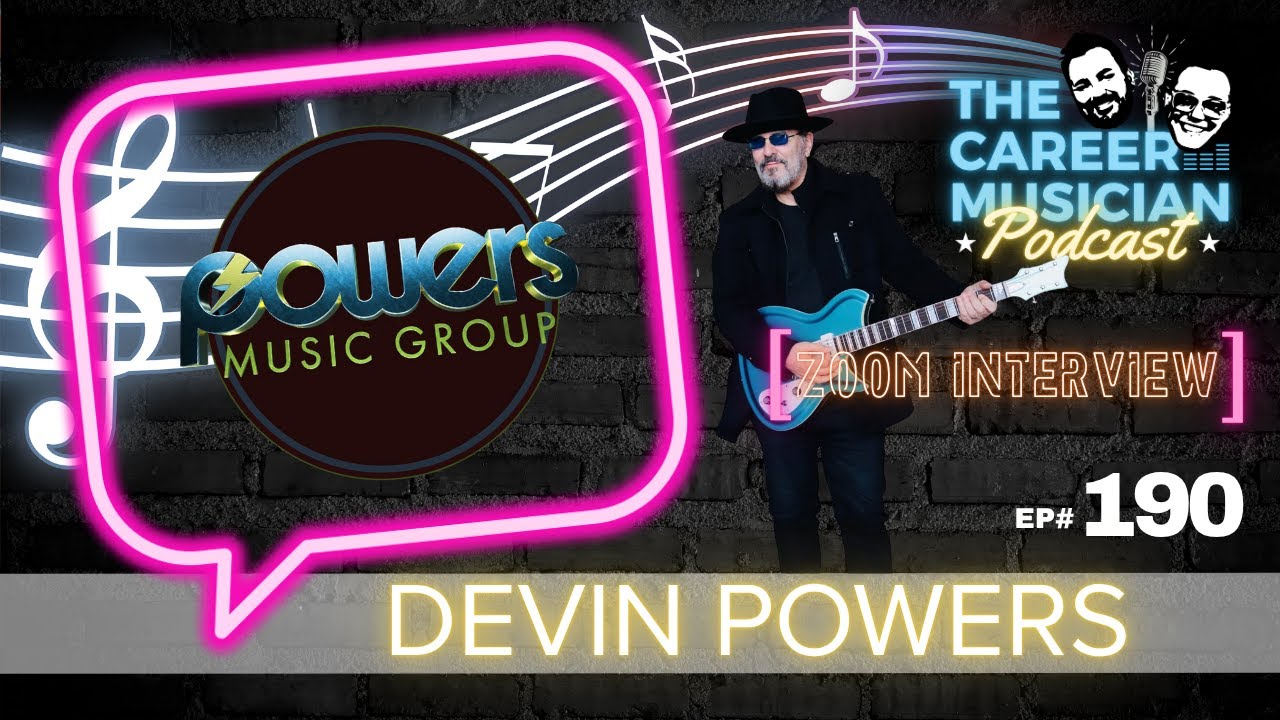
Devin Powers on How to Get Into TV Music as a Composer (Episode 190)
Work begets work.
Ask Devin Powers for his three tips as a composer and you get one word, three times: clients, clients, clients. In Episode 190 of The Career Musician, Nomad sits down with the TV composer and music library founder, who has scored unscripted hits like Blind Date and Naked and Afraid, for a masterclass on how composers actually make it in TV music and stay working.
New co-host Joel Meza joins Nomad for the intro. Joel's verdict: hit after hit of pro tips you can use daily, from someone with 27 years in the game. If you want to know how to get into TV music, this is the episode.
Clients, clients, clients
Devin borrowed the line from real estate's "location, location, location." Everyone playing this game is good at what they do. What separates people is relationships.
"What's the three tips you can give me as a composer? I always say clients, clients, clients."
Devin Powers, 16:06
His career proves it. When reality TV started around 1998 and 1999, he says, hardly any musicians wanted to do it. He came in as a rock guitar player and landed Blind Date, a syndicated show with 175 to 190 episodes a season, and became known for banging out quality tracks at a budget the production could afford. He did around 1,600 episodes for that team. Years later, the same people brought him back for Naked and Afraid.
In the intro, Joel adds that it doesn't matter how good you are if you are doing it in your basement and nobody sees it. Stop over-optimizing your skills in a small town. Go where the work is and build relationships with a long view, like a farmer planting seeds. Some come up in six months, some in ten years.
Always overdeliver
Devin's rule came from his father, who had a sixth-grade education: make yourself irreplaceable by doing way more than is expected.
"Someone says, 'I need you to write five tracks in this style.' You do 20 tracks."
Devin Powers, 21:20
Then tell them they can pick their five favorites, or you can work something out for all 20. He gets calls from composers every week, and when he asks if they can do 10 or 15 tracks a month, some say they couldn't do that much. His answer: work on that. Don't overthink underscore for a crime show. Make it clever, keep it from getting boring 30 seconds in, and always come in above par. That is Energy from the ETHOS code, and it is how work begets work.
He also says he gives cues to young producers and random people in a pinch, like a producer who couldn't clear a song and was over budget. Alliances matter. The person you went to school with could become the next big director.
Templates and the never-close-the-session trick
Devin's breakthrough came while fixing a film score with long reels. Instead of opening and closing a session for every cue, he scored for 15 to 18 minutes straight in one session. He still works that way for batches of music.
Two wins. It saves time on loading templates and plugins. And because every cue runs through the same mix chain, a batch of 20 crime cues comes out cohesive and level-matched. Editors call to say everything fits together. When a show asks for more like a cue from two years ago, he opens that same session, starts after the last cue and keeps going with the same sounds. Nomad and Joel do the same with their playback templates, color coding included.
Write for the editor
This is the part most composers never hear. Editors see cues as waveforms in Avid. If a cue has no good stops, they won't even pull it, because they need cut points. So build them in: a cool sound to sting in, a stop around 25 or 30 seconds, a build, and an ending that rings out so they can go to commercial.
His other insider tip: editors typically drop the level of incoming cues by about 8 dB. Smashing your cue for loudness doesn't help. Dynamics do. And remember who you are serving. Editors like cool cues, and they want to get home to their families on Friday night. Help their cut get approved by the lead editor, the showrunner and the network, and they will love you.
"There's two things you got to know about editors. They like cool cues and they want to get home Friday night to their family."
Devin Powers, 40:58
Alternate mixes and stems
For each cue, Devin's team delivers about 20 to 25 versions. The full mix, a drum down and a drum low (because as a cue gets quieter, drum transients jump out under dialogue), no drums, percussion and sound effects only, sound hits and swipes, then stems by instrument group. It started at Blind Date, when an editor told him a great cue was useless because a flute came in at 13 seconds that didn't fit the scene.
Nomad explains the difference for listeners. Alternate mixes are versions you choose to build. Stems are instrument groups. Either way, everything must start at bar one, beat one and run the same length, silence included, so it all lines up. Milk every cue for every version you can. A favorite cue can even become a show's theme.
Devin calls his music custom score rather than library or production music: anything pre-recorded and not scored to picture. And he jokes about the old ASCAP line, "How's your shaker cue doing this year?" If a show uses only the shaker part of a gorgeous orchestral cue, you still get paid.
Protect the value of the work
Devin started his own library around Gene Simmons Family Jewels. The budget was low, so his attorney said he needed to keep the publishing and writing. That library became his business. He also says a time comes when producers have to decide how important the music is. If it isn't, there are free libraries. If they want quality, that is his deal. Sometimes, as his attorney put it, you have to put on your walking boots.
He has lost some jobs holding his rates, and he is fine with it. Undercutting is a race to the bottom for everyone. If you add a lot to someone else's project, ask humbly for a share of the cue sheet or writing credit. That is Savvy with Humility.
Build a team and take care of it
From the start, Devin has let writers who contribute to his library keep half of their writing share on the back end. He tells the story of a writer with four kids who was close to leaving LA, then called him in tears over a $36,000 check from Naked and Afraid. Devin also sends his writers clips of their music in use, just to keep them excited.
Nomad adds his own testimony. His next-door neighbor in Burbank was an editor who asked him for a few cues for a show. It turned out to be Who Do You Think You Are?, and it worked out for years. That is where he learned to build big alternate mix libraries and metadata.
The takeaway
Get clients, overdeliver, build templates, write for the editor, deliver every version, protect your value, and take care of your team. And keep asking questions, because you will never know everything about music. To build the business side, start with the free Get the Gig guide.
Get the gig. Keep the gig. Build the career.
Watch on YouTube or find every episode on the TCM Podcast page.
Your next step
If this episode lit something up, start with the free Get the Gig Guide. It is the career side of being a professional musician, the part nobody taught you.
Got an audition coming up? Grab Nomad’s Audition Secrets playbook, because everything you do is an audition.
And share this one with a musician who needs to hear it.
TCM listeners and readers get 20% off rehearsal studio time at PA Rehearsal Studios with code TCM20.