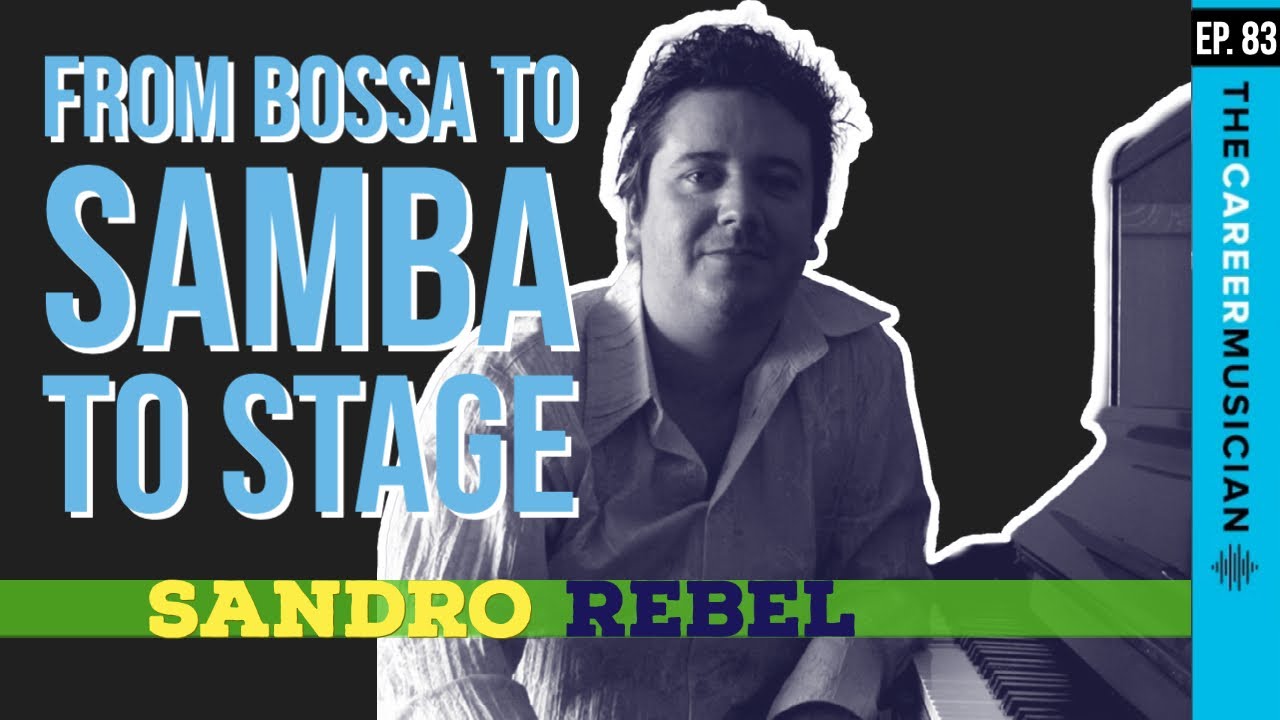
From Bossa to Samba: Sandro Rebel on Reinventing Your Career (Episode 83)
Make Music Your Business.
Ask Sandro Rebel how he's doing and the first words out of his mouth are "reinventing myself." The Brazilian-born pianist, keyboard player and composer has been in the music business for more than 30 years, playing venues like the O2 Arena, the Hollywood Bowl, Radio City Music Hall and the Ryman. In Episode 83 of The Career Musician, he and Nomad talk about moving to America, building a career as a versatile keyboard player, and turning a long-held idea into a new income stream.
If you are an international musician thinking about moving to the US, or anyone trying to diversify your music income, Sandro's path is a useful map.
Reinvention is the job
For Sandro, reassessing himself is not a crisis. It's the profession. Napster, YouTube, the MP3 and the pandemic all changed the business, and he has adapted every time.
"We always have to be reassessing ourselves, our situation, our priorities and make decisions based on that... We gotta adapt ourselves. This is a dynamic profession. It changes with the world."
Sandro Rebel, 3:25
Adapting doesn't mean losing yourself. He keeps his personality, his principles, the music he loves and the people he loves, and looks for the balance. Nomad called it the healthiest way to approach a career: if you expect the pitfalls, you can figure out how to work around them.
From Rio to Berklee to LA
Sandro grew up in Rio de Janeiro in a musical family. His mother studied classical piano for hours a day, and he tells Nomad she grew up practicing four-hand piano with Sérgio Mendes. He started on acoustic guitar at ten, like so many Brazilians, then taught himself piano by translating what he learned on guitar.
He moved to the US in 1996 for Berklee College of Music and found his first room by calling Brazilian students already in Boston. He chose a dual major, music synthesis plus contemporary writing and production, because he already had the playing chops and wanted the knowledge he felt was missing back home. He still took every improvisation and ensemble class he could qualify for.
After graduating in 2000, he headed to LA, partly for the weather and partly for the diversity of opportunity, including music for media. His first work came through the Brazilian community, then referrals. But he didn't want to be only "the Brazilian musician." He wanted to expand his horizons as a person and as a player.
Versatility takes you everywhere
Sandro has played with African, Iranian and Persian, Latin, Brazilian and American artists. He spent close to two years touring with Frankie Valli, including a year of 64 shows in 45 cities, and he was struck that every single night, Frankie brought the energy and kept trying to improve the show. He also plays gospel at a church in Los Angeles, works in LA's huge Persian music market, and has toured world music festivals in around 15 countries with a Cape Verdean singer.
He likes it that way. Being versatile challenges him and keeps him out of his comfort zone. Nomad, who loves playing everything too, said that's exactly why they hit it off from the start. Work begets work, and the more lanes you can play in, the more doors open.
His touring tips are practical: pack light, keep snacks on you because you never know when the next meal comes, keep a small toiletry kit, eye mask and earplugs at your seat, and protect your sleep. Nomad's addition: if jet lag gets you up early and you work out, build in a nap before the gig.
Give the player room in the studio
Sandro and Nomad connected most in the studio, working on production music for Megatrax. From the producer's chair, Sandro's approach is to give a great musician a little freedom first.
"Let the person get acquainted with the music and do his or her thing for a minute before you impose... You never know, maybe they'll have better ideas."
Sandro Rebel, 37:41
Then, once he has heard what they bring, he steers toward what he needs. He has now made four albums of Brazilian music for Megatrax, some with placements on Brazilian soap operas, plus a commissioned project of Rio's choro standards that passed 200,000 streams on Spotify. His lesson from that: the streams came from Latin America and Mexico, and reaching other audiences takes campaigns, time and money. He also quoted advice from a previous TCM guest: don't put all your eggs in one basket, and don't rely on one client for 100 percent of an asset you are building.
Diversify, and keep your main thing
Sandro's newest venture is Brazilian Percussion Loops, an online product of authentic Brazilian rhythms he recorded in Brazil with one of the country's top studio percussionists. He recorded it eight years before launching, and the idea sat in his head for four years. That's how long a side project can take. Now he is learning to run Facebook campaigns, which he calls an art of its own.
That's Diversify or Die in action. But Sandro is careful about it. He's a keyboard player, composer, producer and now an e-commerce seller, and he doesn't want to stop being a keyboard player. So he schedules time for each hat based on his goals.
"What do you like to do, what is the market looking for, and what are your money aspirations... Those are things that you have to balance when you're defining your future."
Sandro Rebel, 48:31
The takeaway
Sandro's advice for musicians coming to America: learn the language, be organized all the time, and be open to different cultures and traditions, because you will grow as a person and as a musician. Find balance between your personal and professional life, and inside your professional life too. Nomad's version of the question: what do you like to do, and what do you have to do to keep the bills paid? If you want a simple way to plan those hats, start with the free plan of attack (POA) worksheet, then grab the free Get the Gig guide.
Get the gig. Keep the gig. Build the career.
Watch on YouTube or find every episode on the TCM Podcast page.
Your next step
If this episode lit something up, start with the free Get the Gig Guide. It is the career side of being a professional musician, the part nobody taught you.
Got an audition coming up? Grab Nomad’s Audition Secrets playbook, because everything you do is an audition.
And share this one with a musician who needs to hear it.
TCM listeners and readers get 20% off rehearsal studio time at PA Rehearsal Studios with code TCM20.