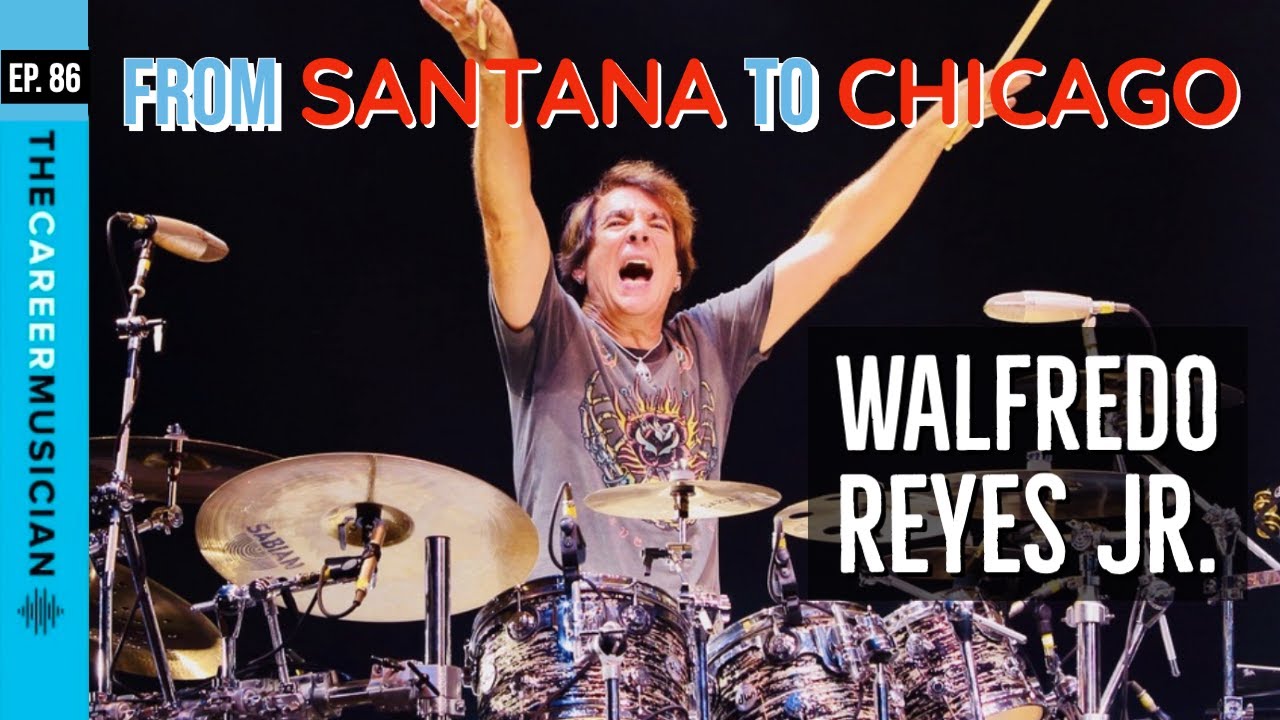
It's Not About You: Walfredo Reyes Jr. on Becoming a Professional Drummer (Episode 86)
Reliability beats virtuosity.
Few drummers can fuse Latin, Afro-Cuban and world percussion with the drum set the way Walfredo Reyes Jr. does. Wally sounds like a drummer and a percussionist at the same time, and that "one man percussion show" has toured or recorded with Carlos Santana, Steve Winwood and Traffic, Jackson Browne, Gloria Estefan, David Lindley, Lindsey Buckingham, Chicago and many more.
Wally was born in Cuba, left at five, grew up in Puerto Rico, and moved to Las Vegas at 13 when his father landed a house drummer gig. In Episode 86 of The Career Musician, he and Nomad, who share Cuban roots, talk about what it takes to become a professional drummer and, more importantly, to stay one for decades.
Rudiments first
When Wally asked his dad for drum lessons, he expected a drum set. He got a practice pad, a metronome and a book of rudiments, and he paid dues for three months. He compares it to sports: no boxing coach throws you in the ring before you've done the drills.
His other analogy: you can throw stuff in a frying pan, but it's better to know the recipe. A cha-cha, a rock beat with a cowbell, every groove has its ingredients. His dad pioneered mixing percussion into the drum set, playing kit for the American dance music and timbales and congas for the Latin band from the same stool. Wally grew up seeing no division between the two.
Don't make sweaters in the Sahara
Wally was busy in Las Vegas, but it felt like a cap. Then a band he loved called: drummer Carlos Vega had recommended him. The leader asked when he would be back in town. Wally lived in Vegas. They needed everyone in LA. So in 1980 he moved.
"If you make really great sweaters, don't move to the Sahara Desert, because they'll never be used... The art is one thing. Okay, I make the best sweaters in the world, but where do they need the sweaters that you make?"
Walfredo Reyes Jr., 19:23
From 1980 to 1984 he paid dues: road gigs with entertainers, club gigs, rehearsals, and every sub call from friends who couldn't make a date. His rule for players without a day job: get a job in the music business. He played Persian gigs, salsa, top 40, weddings, church, chamber orchestra and jazz clubs, anything with the word M-U-S-I-C on it. A lot of musicians who arrived when he did gave up and left. The long haul, he says, is until you do it.
One thing leads to another
In 1984 he toured the world with Brazilian pianist Tania Maria. At the New Orleans Jazz Fest, someone asked if he wanted to audition for David Lindley. Lindley's first club gig had Jackson Browne and Joe Walsh in the audience. Lindley opened for the Grateful Dead in front of tens of thousands, and when they opened again with Santana on the bill, Carlos noticed the guy on timbales and called him.
Nomad's point: you couldn't orchestrate that trajectory if you tried. Wally's: sometimes you go for one goal and you are given other things to the left and the right. Don't ignore the gift. That is Work begets work.
It's not about you
Wally calls himself spiritual more than religious, and he follows one rule he finds in almost every tradition: do unto others as you would have done unto you. It starts with making his wife coffee in the morning, and it goes straight to the drum chair.
"There's a singer that's just about to come into the microphone... quiet down and let her express herself. There's a guitar solo, okay, quiet down and make that guy feel good... It's not about you. It's about them."
Walfredo Reyes Jr., 26:48
Nomad has proof. Years ago he asked Wally to play percussion at a tiny coffee shop gig for a little something, and Wally showed up with his rig and treated him like he was Santana. Wally's answer comes from a lesson he passes on to his own kids: play your heart out the same for five people or 500,000. That is Humility from the ETHOS code.
A professional is in service
Every artist wants something different. Lindsey Buckingham and Steve Winwood wanted the same tempo every night. Santana wanted it different every night. Wally thinks of himself as a music restaurant.
"I know a couple of amateur drummers that play circles around me... but they have not made a personal choice to be of service to a client."
Walfredo Reyes Jr., 35:02
If the client orders two eggs over easy, no salt, you don't bring them your fanciest dish. That is Reliability beats virtuosity in one plate.
Listening is the other 50 percent
As a young player in LA, Wally sat in on a session and watched Steve Gadd sit on his drum stool for about an hour without touching the drums, just listening while the musicians talked through the music. Years later, after a Santana show, Wally got a note at his hotel: "Wally, you were on fire tonight." Signed, Steve Gadd. He framed it.
His lesson: technique, coordination, tuning and reading are 50 percent. The other 50 is listening, including listening for when not to play. He asks drummers in the car what the song is about, and they can tell him the bass drum size but not the lyrics. Drums are the vehicle to the music, not the other way around. And he passed along a line from Steve Ferrone: when he has the urge to do a drum fill, he doesn't.
Nomad added his own Steve Ferrone story: a session at a new studio took six hours to set up, and Steve sat in the lounge without one complaint. When they finally started, they cut the whole album in three hours. That is Low maintenance / no drama.
How you keep the gig
Wally joined Chicago almost by accident. He subbed on percussion for his brother for a week, and on the third night Robert Lamm came to the dressing room and invited him on the bus. He bought the band's first album with lawn-mowing money as a kid in Puerto Rico. In 2018 he moved to the drum chair, and the band had one request: never make them wonder where one is after a fill.
His long runs come from serving the music and protecting balance. He stepped away from the Winwood gig during a hard divorce to raise his kids. Chicago keeps tours to a few weeks at a time so families are not hurt. And he is honest that you can't be a full-time everything: you can be the best part-timer ever. The only competition he is in, he says, is with himself.
The takeaway
Learn the recipe. Go where your sweaters are needed. Pay your dues, say yes, and let one thing lead to another. Then serve the music, listen more than you play, and protect the life that lets you keep doing it. Wally's own phrase for it became the title Nomad suggested for his future book: go beyond the cymbals. When you're ready to go after your next one, prepare with the free Audition Secrets guide.
Get the gig. Keep the gig. Build the career.
Watch on YouTube or find every episode on the TCM Podcast page.
Your next step
If this episode lit something up, start with the free Get the Gig Guide. It is the career side of being a professional musician, the part nobody taught you.
Got an audition coming up? Grab Nomad’s Audition Secrets playbook, because everything you do is an audition.
And share this one with a musician who needs to hear it.
TCM listeners and readers get 20% off rehearsal studio time at PA Rehearsal Studios with code TCM20.