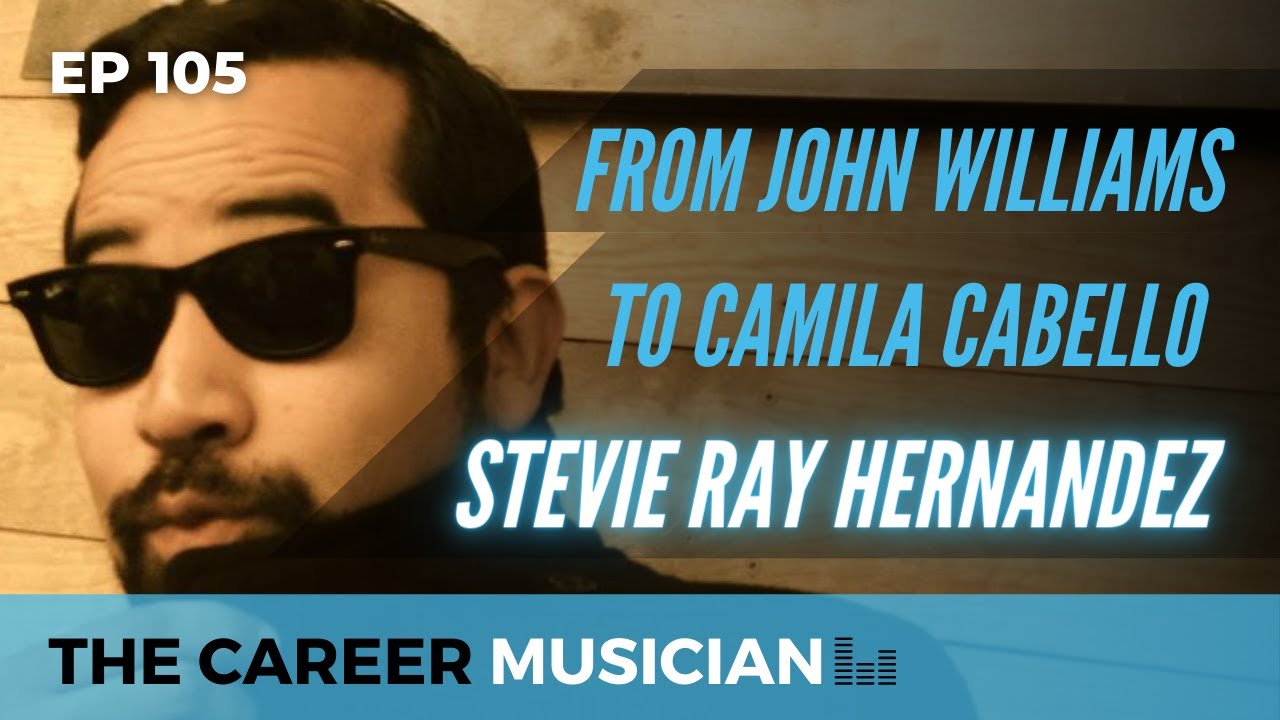
From John Williams to Camila Cabello: Stevie Ray Hernandez on Session Percussion (Episode 105)
Reliability beats virtuosity.
Born and raised in Los Angeles, Stevie Ray Hernandez is one of the most sought-after young percussionists in Hollywood, known above all for his versatility. He has performed with the Los Angeles Philharmonic, John Williams and Gustavo Dudamel, and with artists from Sara Bareilles and John Legend to Camila Cabello and Kanye West. You've heard him on TV on American Idol, The Voice and Dancing with the Stars.
In Episode 105 of The Career Musician, Nomad and Eric G (who has known Stevie since college) asked how a session percussionist builds that kind of range, and how you actually break into the scene. Here is what Stevie shared.
Versatility is a skill you practice
Stevie's main focus in college was classical percussion, but he also played in the jazz combos and the Latin band. A teacher there drilled into him the value of being able to do a lot of different things instead of sticking to one, and in LA, that is what keeps you working. Eric's proof: if he needs a jazz trio drummer or a salsa player, he calls Stevie.
His practice came in waves. Some months it was all timpani. Some months it was all congas, to the frustration of his teachers. What tied it together was the foundation: keeping his rudiments up on a pad, because that filters into everything from drum set to xylophone to timbales.
Playing drums with an orchestra is a different job
The first time Stevie played drum set with an orchestra, it felt totally weird after years in garage bands. You watch the conductor, play the dynamic on the page, and stay solid even when the strings are behind you, because your job is to be the rock everyone anchors to. In the percussion section, time is more fluid, and at a venue as big as the Hollywood Bowl the strings can be 50 feet away and hard to hear.
He described a Coco live concert where one rehearsal was spent running a single song for two hours to get the staging right, and the full movie score was run maybe once before the show. Everyone was hyper-focused. That's what big productions are like.
Relationships, earned organically
How do you break into the upper tier of working musicians? Stevie's answer was relationships and friendships. If you want a certain kind of gig, find out who does that gig and get to know them. The hard part is doing it genuinely instead of forcing it.
"For me it's always been developing relationships with people... but making it organic, to the point where, oh yeah, this person is really my friend and I can trust them."
Stevie Ray Hernandez, 23:06
The orchestral world works more like an apprenticeship: the people you study with often bring you into the scene. Nomad agreed. It has to be organic, and that takes time. Work begets work.
Early is on time
Stevie says he changes hats so often now that he doesn't think about it. One week last year: a session, then a week of Coco rehearsals, then a full day of pop band rehearsal for TV. His prep depends on the gig. For TV, he learns the tunes in advance and maps his parts on his iPad charts: congas here, tambourine there. For orchestral and film dates, where you often see the music for the first time on the stand, he shows up early to set up and read ahead.
One unwritten rule of the film scoring scene he learned: percussionists get there an hour early, because there is gear to set up and the section leader has to assign parts. Nomad added the LA studio-lot math. If downbeat is at two and you need to be in the room at one, be through the gate by 12:30, which might mean leaving home at 11. If you are way early, go get a coffee nearby.
"You're so much more relaxed when you actually have to play. You play better."
Stevie Ray Hernandez, 29:53
That is Luck = preparation + opportunity, and Low maintenance / no drama, in one habit.
The tambourine pays
What does Stevie record most? Tambourine, conga and shaker, and on TV, tambourine more than anything. Nomad loved the honesty. People dream of exotic setups, and then get hired to play tambourine. But playing it well and staying in the pocket is hard, and the Motown and gospel tambourine styles run deep.
He also explained the union side. He joined about ten years ago when a sideline gig on a TV show required it. Most major film and TV work is union, and the back end, like the yearly film fund checks, can outlast the session by many years. His advice to younger players: don't join until you have to.
The takeaway
Stevie's definition of success is shifting. It used to be checking off dream gigs, like playing with the LA Phil and with Sara Bareilles. Lately it's the shows he produces himself with hand-picked musicians, like a yearly Jeff Buckley night, where people come up crying afterward. His advice to his 19-year-old self: don't be afraid to fail. Take the audition. Go sit in. The times he did, he had the most amazing experiences. When your shot comes, prepare like a pro with the free Audition Secrets guide.
Get the gig. Keep the gig. Build the career.
Watch on YouTube or find every episode on the TCM Podcast page.
Your next step
If this episode lit something up, start with the free Get the Gig Guide. It is the career side of being a professional musician, the part nobody taught you.
Got an audition coming up? Grab Nomad’s Audition Secrets playbook, because everything you do is an audition.
And share this one with a musician who needs to hear it.
TCM listeners and readers get 20% off rehearsal studio time at PA Rehearsal Studios with code TCM20.