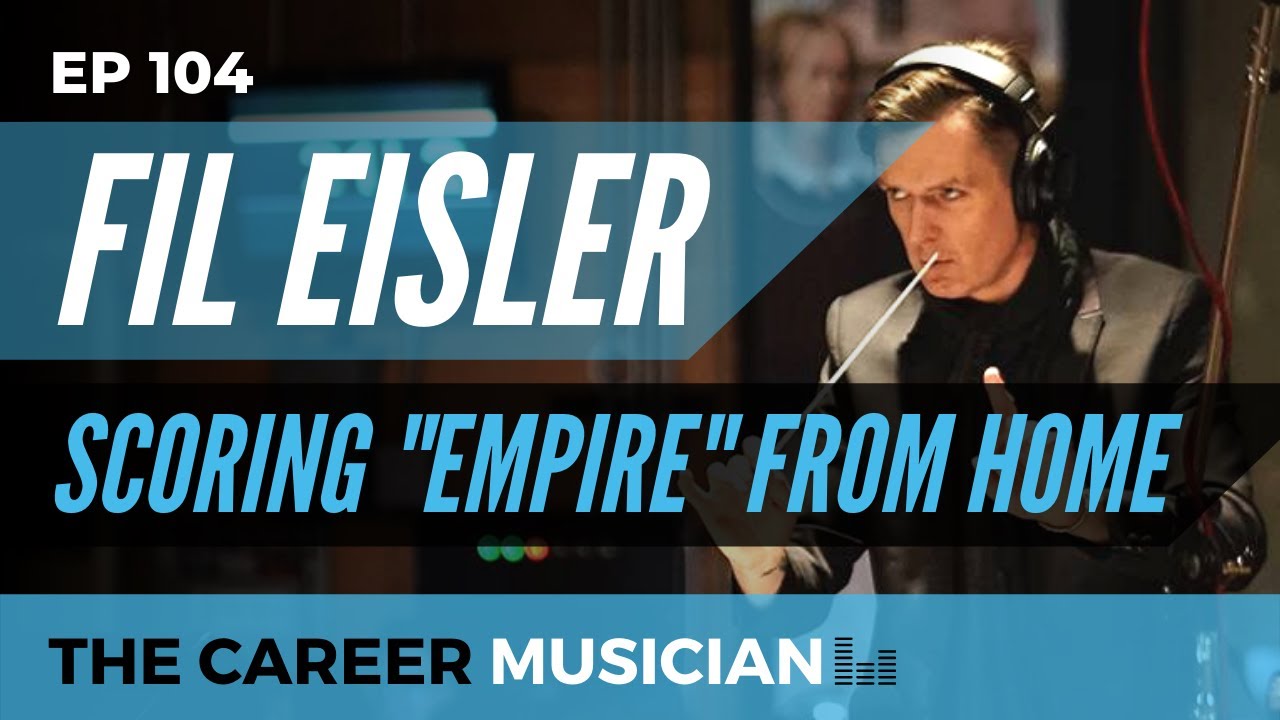
Scoring Empire From Home: Fil Eisler on Becoming a Film and TV Composer (Episode 104)
Make Music Your Business.
Fil Eisler went from playing guitar in Robbie Williams's band to scoring some of TV's most binge-worthy shows, including Empire. Along the way he co-wrote songs on Williams's multi-platinum album Reality Killed the Video Star, worked with Ryan Adams and Dave Stewart, went through the Sundance Film Composers Lab, and scored films like Proud Mary and How to Be Single.
In Episode 104 of The Career Musician, Nomad talked with Fil about the move from touring musician to film and TV composer, why the best composers build great teams, keeping a TV orchestra working from home during the pandemic, and learning to conduct by doing the thing that scared him most.
Listen to yourself more
Nomad opened with a question about names. Fil spelled his name with a Z for years after a producer suggested it in his band days. By his mid-to-late 30s it felt a bit daft, so he took his real name back. His bigger point was about advice in general.
"If I was going to go back and give the younger me any advice, it would be to listen to the people around me less... You've got to listen to yourself more."
Fil Eisler, 2:33
That doesn't mean ignoring mentors you trust. It means having the strength of your convictions. Years later an agent told him not to pursue orchestral work because every kid out of film school was doing it. He ignored that advice, and his tip for the day was simple: don't surround yourself with people like that.
Take the gig, and love the band
Fil was born in Prague, where Western pop was mostly unavailable, and grew up on a handful of his parents' Beatles and Dylan records. His dad brought home a department store guitar, taught him a few chords, and by eight or nine he knew this was his life.
As a young indie kid in London, he nearly turned down the Robbie Williams gig because Williams was known for being in a boy band. Then his flatmate pointed out that he hadn't paid rent in six months. He met Robbie, they got on great, and when he heard the demos he knew Robbie was the real thing. The band started out playing theaters they couldn't fill. Through touring, touring and more touring, Williams became one of the biggest artists in England and Europe within about a year.
Before all that, one of his first jobs was sweeping floors and making tea at a rehearsal studio in South London. When the rooms were empty, he practiced. He pestered his way into running the little 16-track demo studio, and the engineering basics he learned there still serve him today. Luck = preparation + opportunity.
Hire brilliant people and let them work
When Fil moved to LA to be with his wife, he didn't know anybody, and for a while he flew back to New York and the UK for sessions to pay the mortgage. Film took off bit by bit. Today he runs a studio on the Warner Bros. lot, set up to recapture the collaborative feel he loved at the Sundance labs.
His plan for TV, where the workload is enormous: hire brilliant people and let them do their jobs. You'd be surprised, he said, how few people do that.
"The key to delegating successfully is getting good with the fact that other people are going to impart their fingerprints on your stuff... They're going to bring something to it, and why wouldn't you want them to?"
Fil Eisler, 22:45
It takes letting go of your ego, and staying open to happy accidents. Records are made in teams. Films are made in teams. The idea of the director who does everything alone is a myth. That is Humility from the ETHOS code, and it is also good business. He also confessed that the deadline is his best friend. Without one, he doesn't have the same drive.
Keep the players working
When the pandemic hit, Fil and a few other composers pushed the studios to keep recording remotely. A handful of musicians were relying on the income from the final weeks of Empire, and they had mortgages to pay. So they helped set the players up to record from home. Looking back, he said, almost every musician in that orchestra now has a home recording setup.
His view: the remote experiment was great, but it is no substitute for an orchestra in a room. Still, this is the age of making stuff. Nomad's message to every player listening: if you don't have a home setup yet, get one. Diversify or Die.
Fall in love with what scares you
Fil had barely read music since he was 18 or 19. Session work never required it. When BMI offered him a spot in a conducting fellowship sooner than he expected, he had about three months to get his reading back. On day one, the teacher called him up first to conduct Beethoven's First on two pianos. It was a train wreck. They videotape you, and watching it is, in his words, a crushing ego murder. But he fell in love with it, and today conducting is his favorite part of the job: the last chance to shape the music with the players in the room.
He's taken up jiu-jitsu and skiing in his 40s for the same reason. Time is precious. If you love something, do it.
The takeaway
Trust your own voice. Say yes to the gig that might surprise you. Build a team of people smarter than you and let them leave fingerprints. Look out for the players who make your music possible. And walk toward the thing that scares you. If you are preparing for that next opportunity, start with the free Get the Gig guide.
Get the gig. Keep the gig. Build the career.
Watch on YouTube or find every episode on the TCM Podcast page.
Your next step
If this episode lit something up, start with the free Get the Gig Guide. It is the career side of being a professional musician, the part nobody taught you.
Got an audition coming up? Grab Nomad’s Audition Secrets playbook, because everything you do is an audition.
And share this one with a musician who needs to hear it.
TCM listeners and readers get 20% off rehearsal studio time at PA Rehearsal Studios with code TCM20.