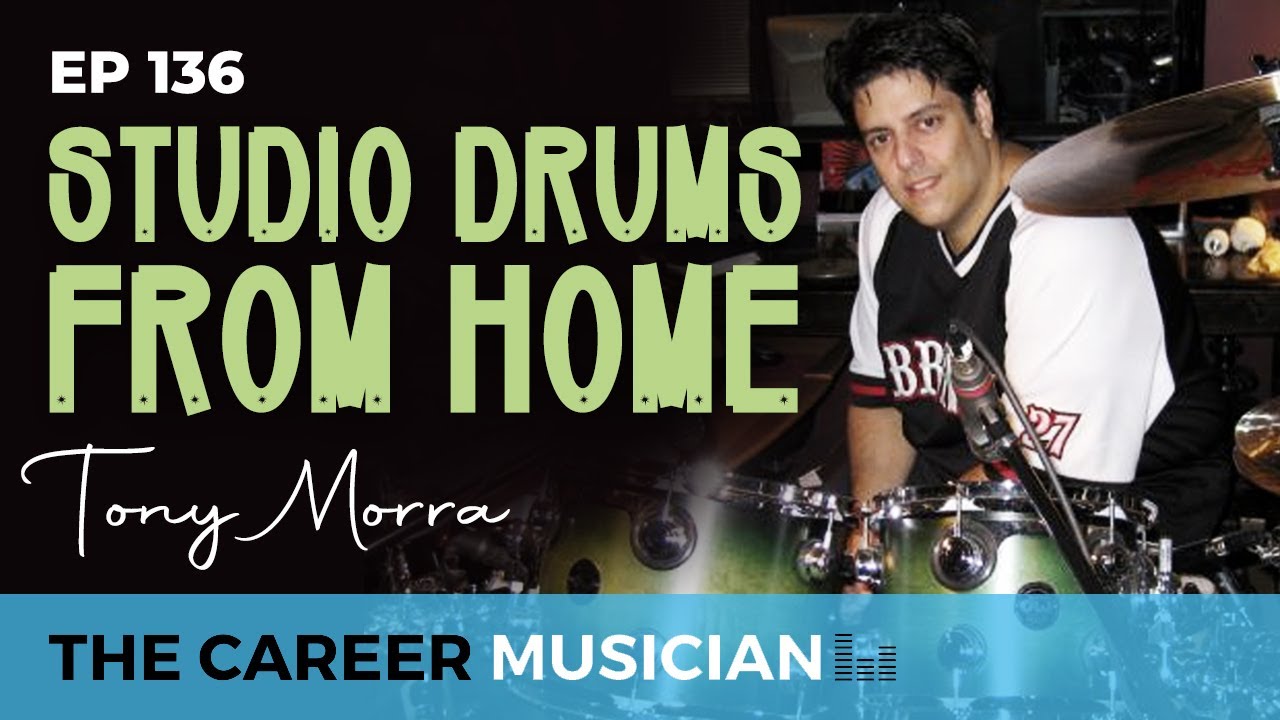
Tony Morra on Recording Studio Drums From Home (Episode 136)
Reliability beats virtuosity.
Tony Morra (Anthony J. Morra, if you ask his family) is a New York drummer who moved to Nashville in 1997 and became one of the early pioneers of recording studio drums from home. His credits run from Phil Ramone, Diane Warren, Donna Summer and Bruce Springsteen to Katy Perry, Taylor Swift and Carrie Underwood, plus a long list of contemporary Christian artists like Amy Grant, Avalon and Kathy Troccoli.
Nomad and Tony go way back in Nashville, including the sessions for Nomad's album at Dark Horse Recording in Franklin. In Episode 136 they cover how to record drums at home so they sound pro, how Tony built his career on both sides of the glass, and why "they'll find you" is the biggest myth in the business.
Home recording has to sound like the real deal
The days of 10, 2 and 6 o'clock studio sessions are mostly gone. For Tony, a lot of the work is files: check the transfers in the morning, play, send it back. That opens doors to play with people all over the world, but it is ridiculously competitive. The track he sends might go to a bassist, then a guitarist, then a big room where the producer records an orchestra. It can't sound like a demo.
His room started as a little utility room off the garage around 2000. A few years later he played six songs for an album while Steve Ferrone, one of his New York mentors, cut the other six in a big studio. Months later, the mixer, an editor at Mix magazine, called with questions. Tony braced for a list of everything he was doing wrong. Instead, the mixer said he was turning things off.
"I'm basically not doing anything to your drums, and they sound great. What the hell are you doing?"
Tony Morra, quoting the mixer, 12:00
Mix ended up featuring his room in 2003. Some studio engineers accused him of trying to put studios out of business. He wasn't. He was just trying to play on songs, and he knew from New York, where drums sometimes went in the vocal booth, that you can make drums sound great in a small space.
Get the sound before it hits the computer
So what separates the A-list player from the cheaper one when the files arrive? For Tony, it is the signal chain.
"For me, it's all about how you send your signal into your interfaces, into your computer. What's going there before it's being recorded."
Tony Morra, 18:20
Plugins are getting better, but fixing drums after the fact tends to make them thinner and more compressed, with artifacts that limit the mixer. Then the mixer starts replacing sounds, which is more work for them. His advice:
- Before you buy a drum set, spend $200 on a good throne. Save your back.
- Invest in a great computer and good outboard gear, at least for kick, snare and overheads. Financing with no interest is out there, so don't rob a bank.
- Educate yourself on the classic gear: what a Neve, an API or an 1176 is. Then a hardware box built to sound like one will usually beat the plugin, because the color goes on before it hits the computer.
If the sound going in is great and the mixer just brings the faders up, people will want you on their records. Work begets work.
Learn the glass side of the studio
Tony learned engineering in New York working at jingle houses between tours. He worked in a jazz drum shop, saw a LinnDrum for the first time, and talked his father into a loan for an E-mu SP-12. After his own sessions he never left. He stayed to watch, and met the singers and horn players.
That led to an internship in a jingle composer's studio near 23rd and 5th, where a young Mariah Carey was working on her first record in a back room at night. When the studio was dark, Tony turned the kitchen into a drum room and brought in his bands, which led to years touring with the freestyle group Sweet Sensation.
His advice to players: if you get a chance to intern at a studio, take it, even unpaid, and learn the process. One day the engineer didn't show up, and Tony was the engineer. Engineering and drum programming kept him working when tours ended. Other players came home to phone sales or waiting tables. Tony came home on Sunday and had a session on Monday. That is Savvy from the ETHOS code. Diversify or Die.
Be inventive, and the gig follows
Back in New York, Tony subbed for a big Kathy Troccoli concert the night before a papal mass in Baltimore. Her backing tracks played from a CD or DAT, with click on the left and music on the right, and the count-offs were a mess. Using the jingle studio's two-inch machine, he re-edited every track so each song had eight clicks, and slated the song name on the click side so he always knew where he was if the player skipped. When the DAT player got left in New York, they bought a CD player and set it on pillows. The show went great.
Four days later Kathy called and asked him to be her drummer. He played with her for three years, opening for Bryan Adams and Michael Bolton. When he moved to Nashville in 1997, he arrived as music director of her first headlining Christian tour, the new guy in town calling players to hire them. Luck = preparation + opportunity.
He also knew his worth. When a tour offered $125 a night for drums plus setting up and tearing down the lights, he respectfully declined. He made $300 a night playing weddings in New York.
No one is looking for you
A contact once told Tony in Nashville she had never heard of him. Nomad and Tony agreed that's normal. Producers have their people.
"The biggest fallacy is, they'll find you. Because you know what? No one's looking for you."
Tony Morra, 54:45
You have to put yourself out there, respectfully. Make the calls, be confident, and be able to back it up. If you are hiring a lawyer, you want the one who says you are never going to jail, not the one who says he is okay. Nomad added: it doesn't matter if it's the phone, texts or DMs. You can't sit and wait. Methods change, but principles remain the same.
Remote sessions and the tech you need to learn
Tony has tested years of remote session tools so clients can hear him in real time: early services that fizzled, Nicecast, then Audio Hijack streaming to a rented server, where the client just clicks a link. He recently played a live session with an artist in Virginia using Jamulus, where talkback and music share one app with little delay. Nomad uses Audiomovers. All of them take some creative audio routing and some reading.
Good enough won't last
Tony's warning for young players: technology lets you get by being good enough, because editing fixes a lot. But good enough hits a wall.
"The guys that are going to last are the guys that grow with it and learn and get better and better and better."
Tony Morra, 1:10:30
A former intern who had done about four sessions on his own got called for a low-budget date. He asked for the music ahead because he couldn't sight read, got through two songs, then the producer asked for Blastix, brushes and a new bridge rhythm. The third song took almost the whole session. In this business, Tony says, you often get one shot. Your friends' ears are not the ears of the person paying for the studio.
His definition of success: at 57, he pays the mortgage, sends his kids to school, has a loving family, and still does what he loves. He asks every artist he produces whether they want to be successful or famous. Fame can burn out fast. Success equals longevity.
The takeaway
Get your sound right before it hits the computer. Learn both sides of the glass. Be inventive when things go wrong. And put yourself out there, because no one is looking for you until you give them a reason. When that call comes, prepare like a pro with the free Audition Secrets guide.
Get the gig. Keep the gig. Build the career.
Watch on YouTube or find every episode on the TCM Podcast page.
Your next step
If this episode lit something up, start with the free Get the Gig Guide. It is the career side of being a professional musician, the part nobody taught you.
Got an audition coming up? Grab Nomad’s Audition Secrets playbook, because everything you do is an audition.
And share this one with a musician who needs to hear it.
TCM listeners and readers get 20% off rehearsal studio time at PA Rehearsal Studios with code TCM20.